
Cover Story
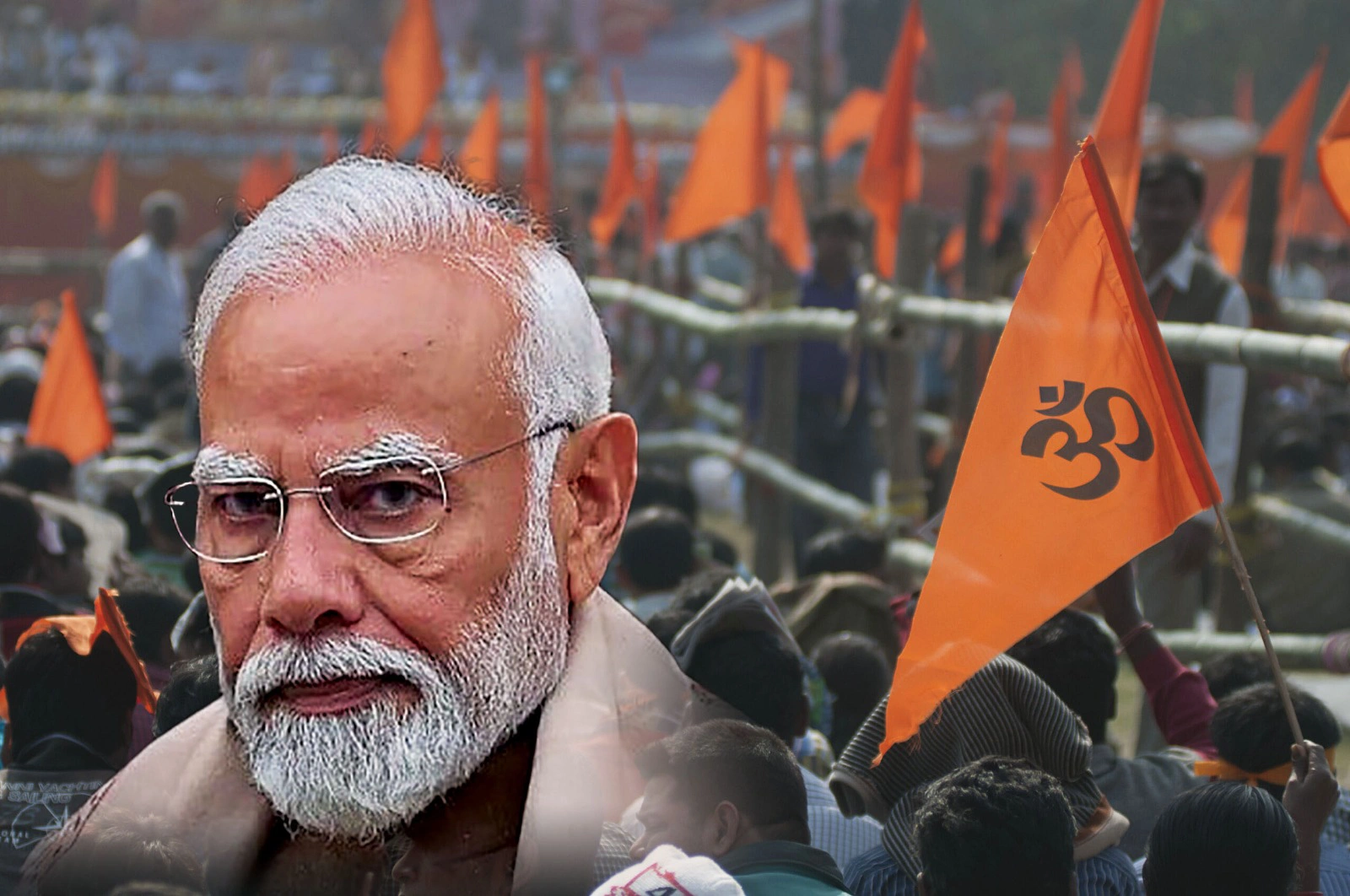
Hindutva Hate Doctrine (HHD)
Just as Hindutva springs from the falsity of Hindu supremacism, so too are Hindutva’s aspirations outside the Indian state fired by a fabricated version of the past

As a historical prelude to a brief elaboration of this essay’s title, one speculation is that the genesis of the Hindutva Hate Doctrine (HHD) virus began with the advent of Islam into South Asia over 1200 years ago. Then, it grew slowly, gradually over the 700 years, when Muslim rulers, representing a minority, dominated vast parts of the region in which the majority of the population was non-Muslim.
Yet, for the most part, there was a passivity to the hate rather than an active facet. And the hate was confined to relatively small numbers despite the deliberate or accidental demolition of temples. Even as the inherently equitable, non-caste-based universality of Islam attracted voluntary, mostly non-violent conversion to its faith of peoples riven by profoundly deep, entrenched caste-divisions, the influx of Muslim Turkish, Persian, Central and West Asian rulers and communities was accepted, even welcomed at times as a relief from entrenched oppression. There were numerous instances where Muslim rulers shared power with non-Muslim princes and generals.
Al-Biruni ‘s prescience:
Recording observations of his travels in the 11th century, Al Biruni of Persia, in his treatise “Kitab al Hind,” was fascinated by the total contrast between communities living side by side while possessing widely different religious, cultural, and ethnic characteristics. Indeed, over time, there was a conscious effort to reinforce the differences because they became an anchor for the identity at birth to stay fixed and unaltered by neighbours. In the 1930s, sociologist Gregory Bateson formulated the term “schismogenesis” to describe this phenomenon that exists in several other parts of our world as well: when one community preserves its sense of self by defining itself as being against, or irreconcilably different from the other.
Perhaps the transition from passive acceptance to active rejection began with the end of the Muslim Mughal dynasty in 1857. Broadly speaking, Hindus began a subconscious and then increasingly conscious search for their new political role over unfolding decades when Muslims no longer wielded superior power, which had been replaced by British power.
The search manifested itself diversely. The reformist, anti-idol worship, anti-caste-based Arya Samaj, founded in 1875, was a significant initiative. A decade later, even though there was only one major Hindu figure among the four co-founders of the Congress Party in 1885 (Surendranath Bannerjee, with two Zorastrians, Dadabhai Nauroji, Pherozeshah Mehta, and one Englishman, Allan Hume), Hindus soon became the leading segment in the secular public persona of the Congress. Thirty years later, from within the Congress in 1915, the Hindu Mahasabha emerged as a pressure group for Orthodox Hindus. Ten years later, in 1925, with a paramilitary face promoting Hindu discipline and character-building, the Rashtriya Swayamsevak Sangh (RSS) laid the foundation for other entities, becoming the driving force behind the upsurge of the BJP in the 1980s, 1990s, and over the past quarter century. Through these phases, for a variety of reasons, assertion became aggression: you had to be Hindu, of whichever caste, for you to have the right to live and thrive in Bharat.
Simultaneously, post-1857, Muslims too began their own search for a new role in times wherein they were substantive in numbers but, in overall regional terms, a minority. Following the successive phases of Sir Syed, the formation of the Muslim League in 1906, the invention of the word “Pakistan” in 1933 by Choudhry Rahmat Ali, and the transformative leadership of Mr. M.A. Jinnah, Pakistan eventually became a reality in 1947 and remained so until 1971.
But even after the disintegration of the original state structure, Muslim nationalism remains the pivotal force in 2025 for the abiding nature of Bangladeshi identity -- while respecting the rights of the non-Muslim parts, which constitute about 10 per cent of the population. Numbers are relevant to note. In Pakistan, non-Muslims are only about 3 per cent, which does not diminish their importance but indeed enhances it. Whereas in India, Muslims as a percentage of the total are about 15 per cent among a total of about 22 per cent non-Hindus.
Pakistan is the only nation-state in South Asia with the will and capacity to confront the external expressions of Hindutva Hate Doctrine (HHD)
Internal impact:
Which brings us to consider the first internal implication for India of the HHD doctrine. In the world’s most populous and diversely composed state, at 1.43 billion in 2023 and growing, with enduring inequalities in multiple spheres, at least 400 million to 500 million remain mired in harsh poverty or severe disadvantage. HHD drives schisms and divisions even deeper.
This leads to the second consequence: weakening the cohesiveness of both society and state, reducing the capacity of institutions to manage severe disparities. Because institutions become vulnerable to elite or partisan control. Already, even the Indian Supreme Court, theoretically the place of last resort to obtain justice, with its bizarre judgment on the wilful destruction of Babri Masjid, has become almost synonymous with Hindutva.
With a huge proportion of its population under 40 years of age, the impact of enfeebled institutions also has ominous economic repercussions, as the third internal implication of HHD. Partly distorted by corruption, partly by policies that favour the rich, unemployment among youth fosters a sense of futility even among Hindus of different castes. The desperation is mirrored by thousands who abandon recently-married women, especially in northern India, to seek legal or illegal migration to Europe and North America or elsewhere, in moving in droves from villages to cities, in proliferation of crimes and violence in congested urban centres to make, for instance, New Delhi compete for becoming the rape capital of the world.
Though the preponderant majority, as with majorities everywhere, accepts the permanence of their place of nationality, the fourth implication is that of alienation: between human and human, between community and community, between religion and religion, and soon, between citizen and state.
Victories in cricket --- particularly against Pakistan! --- and missions to the moon and some economic achievements do bind Indians together with shared pride. However, such euphoria is short-lived. The zealotry encouraged by the extremism of Hindutva soon turns inwards to itself, in a kind of moral self-cannibalism.
Ironically, instead of bringing people closer, the scope of social media for disinformation, hate content, and, more recently, AI-generated fake material, has perversely aided the rapid spread of HHD.
External fall-out:
The first external expression of this disease is delusion: regional and geo-political. Just as Hindutva springs from the falsity of Hindu supremacism, so too are Hindutva’s aspirations outside the Indian state fired by a fabricated version of the past. Greeting entrants into the reception hall of the new Parliament building in the capital city is a map that projects a Mahabharat encompassing not only the existing internationally-recognized territory of the Indian state but also includes the sovereign, internationally-recognized territories of the independent states of Pakistan, Afghanistan, Bangladesh, Nepal, Bhutan, Sri Lanka, and Myanmar.
The arrogance of this fantasy should not distract from its fakeness, nor from what it reveals of the creed’s dreams. At no point whatsoever in recorded history has there ever been a singular political entity comprised of the area depicted in that map. At no point during a Hindutva-driven Indian state’s existence will the other states swallowed by the farcical map permit the absurdity actually to become reality.
To prevent that from occurring, all the states in the region are obliged to deal with the second external fall-out of HHD: a dangerously asymmetric state led by a Government with intrinsically hegemonist goals and impulses.
Between its creation for the first time as a state on 15th August 1947 and the present, even without BJP Governments at the centre, the Indian entity has shown a predatory appetite by forcibly absorbing, seizing, crushing about 550 Princely states that existed until British rule ended. The most graphic and prominent examples are Kashmir and Hyderabad Deccan is in the large category of such Princely states. The annexation of Indian-occupied Kashmir by the BJP regime in August 2019, in violation of UNSC Resolutions, is only the most eloquent, irrefutable demonstration of this expansionist tendency.
It is vital to remember that the large majority of Indian citizens, most of them Hindus, do not accept the thesis of hate of non-Hindus
A third expression outside the Indian state of HHD is the subversion of regional cooperation structures, such as SAARC, which was gradually strengthened over three decades from 1985 to 2016, when a Modi-led Government declined to attend the 19th summit set to be held in Islamabad, on the contrived reason linking alleged “terrorism” against India emanating from Pakistan, and compelled three other states to follow suit.
The evolution of SAARC has thus stalled for almost a whole decade, just when connectivity and convergence mark relations in virtually all other regions. In the fourth manifestation externally, HHD is unable to accept with grace the phenomenal rise of China. India’s obsession is not confined to resisting the visionary global Belt and Road Initiative (BRI) launched by President Xi Jinping.
More specifically focused on its own South Asian region, Hindutva is unwilling to recognize the constructive, peaceful potential of the Pakistan-specific aspect of the Belt and Road Initiative in the form of CPEC. Attendant to this predilection, HHD turns to another hegemon 10,000 miles distant, the USA, to enable both to resist the non-violent, non-aggressive progress of China, whose speed in achieving excellence in multiple domains far exceeds that of both India and America. With its 800 military bases, large and small, around the world, the USA is courted by India to thwart an immediate neighbour.
What will be the future?
Pakistan is the only nation-state in South Asia with the will and capacity to confront the external expressions of HHD. This is why a BJP-ruled Indian state resorts, almost comically, to accusing Pakistan of “terrorism” while itself sponsoring the same evil in Balochistan and KPK, as also its inability to admit its failures in the conflict of May 2025.
Much as HHD is deforming the Indian state and polity, it is vital to remember that the large majority of Indian citizens, most of them Hindus, do not accept the thesis of hate of non-Hindus. In the previous general election of 2024, the BJP and allies secured only 38 percent of the popular vote.
Thus, a representative majority voted against HHD. However, due to the anomalies of the “first-past-the-post” electoral system, the HHD coalition secured a majority of seats.
In the Bihar polls of November 2025, the BJP and its main ally, JD (U), each won 131 seats, securing a landslide victory. Yet HHD was not the principal reason for success. Purely Bihar-specific demographics, partisan alignments, and controversial electoral registration changes, as well as caste and employment-driven factors, reportedly shaped the outcome.
It is worth retaining hope that the better part of the Indian psyche, embodying rich pluralist cultures, will strive to overcome the affliction of the Hindutva Hate Doctrine.
The writer is an author, a former Senator and Federal Minister, and a member of the longest-running ‘Pakistan-India Track II dialogue known as the Neemrana Initiative’ (1992-2015).


Leave a Reply