



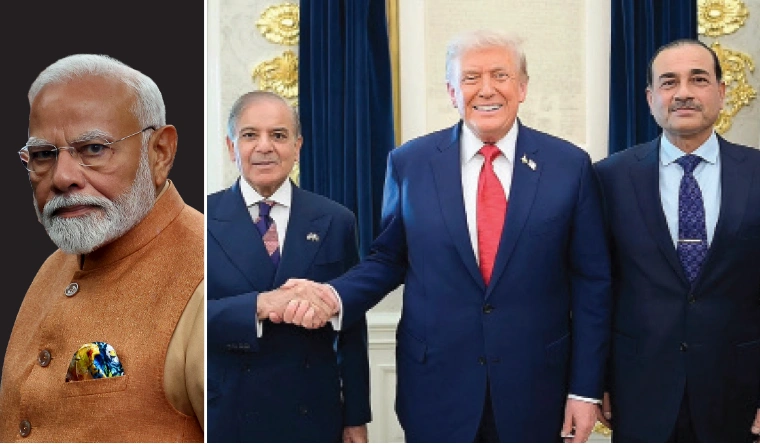
Following a brief India-Pakistan war from May 7-10 this year and subsequent standoff, Pakistan’s diplomatic and power projection surged. It was not only the U.S. President Donald Trump praising Pakistan and taking the credit for averting a nuclear war in South Asia, but it also reflected Islamabad’s renewed diplomatic surge in the Gulf, the Middle East, and other parts of the world.
How Pakistan, which was facing diplomatic isolation and charges of sponsoring terrorism, was able to strike back and re-establish its role in the global and regional setting? How is India perceived as following a defensive line and being unable to respond to the reality that it lost its armed conflict with Pakistan? How can Pakistan capitalize on its diplomatic resurgence and benefit from its prevailing pivotal role in regional and global affairs? Why is the BJP-led government, despite experiencing a military setback with Pakistan, unwilling to alleviate its politics of hate at the domestic level? These are the questions raised by those who see Pakistan’s diplomatic resurgence as both a challenge and an opportunity, despite the BJP’s belligerent posture internally.
Pakistan is trying to seize the opportunity of causing a blow to India during the May 7-10 war. But despite facing a defensive position since its last brief war with Islamabad, the BJP government under Prime Minister Narendra Modi has refused to reform its domestic agenda by mitigating the politics of hate. The politics of prejudice pursued by the Modi government adds to religious and communal polarization in India, which is least helpful for New Delhi to overcome its regional and international limitations.
For critics, it may be a euphoria on the part of the Pakistani establishment that it has greatly benefited from its ostensible triumph in the May conflict with India and is now in a stronger position, thanks to its warm relations with major global powers, particularly the United States, Russia, and China. But the reality on the ground may be different. Pakistan remains in dire economic straits, with its foreign exchange reserves not exceeding $15 billion; its economic growth rate is marginal, and its exports have not surpassed $30 billion. Politically, the establishment, along with its subordinate civilian partners, attempted to capitalize on its claimed victory over India by imposing further curbs on the media, opposition, and taming the judiciary, while accumulating more power in the top echelon of military leadership under the 26th and 27th constitutional amendments.
Those who believe that praise from Donald Trump will enable them to strengthen their hold on power and establish a quasi-military hybrid regime that undermines the constitution, democracy, and the rule of law may, however, be mistaken. Those wielding real power confidently judged that by engineering constitutional amendments, they could ensure the supremacy of security forces in the mode of governance. Against this background, the introduction of the 26th and 27th constitutional amendments was aimed at undoing the supremacy of the constitution, independence of the judiciary, freedom of the press, and ending a level playing field for the opposition. However, while pursuing a hard road of authoritarian governance, those who rule the roost, along with their civilian stooges, are not mindful of the fact that similar efforts in the past have also failed to materialize.
When constitutional amendments are made not for national interests but to ensure the interests and privileges of individuals holding key positions of power, such efforts damage Pakistan’s diplomatic position. The world will not take it positively if endeavors are made to weaken the constitution and judiciary at the expense of democracy, freedom of the press, and an inclusive mode of governance. By taking such measures, Pakistan’s diplomatic edge, which was gained following the May 2025 armed conflict with India, may be diminished. International media and civil society will reject constitutional amendments and efforts to strengthen the position of a few individuals holding positions of power at the expense of democracy.
According to the Daily Parliament Times issue of November 9, “Pakistan’s diplomatic offensive has reached its peak - particularly after decisively thwarting India’s blatant and brazen military misadventure in May 2025. It would not be an exaggeration to state that such a vigorous and impactful diplomatic drive has rarely been witnessed in the nation’s more than seven-decade-long diplomatic history. Recent constructive engagements and carefully coordinated initiatives, under the forward-looking leadership of Prime Minister Muhammad Shehbaz Sharif and the country’s Army Chief, Field Marshal Syed Asim Munir, merit genuine recognition. Through a proactive, soft power–driven strategy aimed at advancing both national and global objectives, Pakistan has significantly elevated its international standing, emerging as a prominent and respected voice on the world stage.”
 Pakistan’s Strategic Mutual Defense Agreement with Saudi Arabia, along with its role in the Doha and Istanbul talks on Afghanistan, reflects Pakistan’s diplomatic success. Pakistan’s seat as a non-permanent member of the UN Security Council and its role in Arab-Muslim talks on Gaza held recently in Istanbul is another evidence of Pakistan’s expanding diplomatic landscape.


Based in Karachi, the writer is a Meritorious Professor of International Relations and former Dean of the Faculty of Social Sciences at the University of Karachi. He can be reached at amoonis@hotmail.com
Leave a Reply