




As Pakistan struggled with climate vulnerability, persistent economic stress, and widening human development gaps, policymakers and business leaders convened in Islamabad at the 28th Sustainable Development Conference and Sustainability Investment Expo, hosted by the Sustainable Development Policy Institute (SDPI). This year’s gathering reinforced a single message that resonated across all sessions: sustainable development must guide how Pakistan grows, not merely accompany it.
Over several days, representatives from the United Nations Development Programme, the International Monetary Fund, the World Bank Group, and senior figures from the private sector discussed how Pakistan can realign investments with climate resilience and inclusive growth. The discussions were shaped by a sense of urgency and an acknowledgment that without coordinated action, the country’s development trajectory may not withstand the pressures of a rapidly changing climate.
During a high-level plenary on financing sustainable development, Dr. Samuel Rizk, UNDP’s Resident Representative in Pakistan, was blunt in his assessment. He stated that Pakistan will require an estimated USD 50 to 60 billion by 2030 to meet the Sustainable Development Goals. He emphasized that raising these resources necessitates financing models co-designed with all stakeholders, structured to balance risk while attracting both public and private capital. In his view, the government will need to lead the charge, but lasting success will depend on broader participation from business, development partners, and communities.
The IMF’s Resident Representative, Dr. Mahir Binici, reinforced this argument by describing climate change as a macro-critical issue that directly affects growth, employment, and fiscal stability. He noted that the IMF’s Resilience and Sustainability Facility is now encouraging countries to integrate climate considerations into major investment decisions. According to him, Pakistan’s ability to withstand climate shocks will increasingly shape its economic prospects.
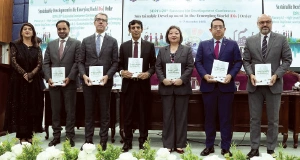 The World Bank’s Country Director, Bolormaa Amgaabazar, added another dimension by focusing on human development. She explained that the Bank’s ten-year Country Partnership Framework for Pakistan prioritizes areas such as nutrition, safe water, hygiene, and behavioral change, particularly given the country’s alarming levels of stunting and malnutrition. She described these issues as interconnected with climate resilience and argued that improving human development outcomes is essential for long-term stability.
 At the plenary session, Nestlé Pakistan CEO Jason Avanceña described the financing challenge as immense but surmountable if new models of collaboration are adopted. He stated that financing sustainable development necessitates mechanisms that integrate public funds, private capital, and multilateral financing, but that these partnerships must ensure equitable access to capital and be grounded in climate-resilient and inclusive approaches. He also noted that Nestlé is aligning its Pakistan operations with its global ambition to reach Net Zero by 2050. This includes over 9.5 megawatts of solar installations, investments in efficient manufacturing technology, and the deployment of a biomass boiler at the company’s Kabirwala factory.
Leave a Reply